Physiotherapy
Individual physiotherapy in Bludenz for pain, movement problems, and rehabilitation after injuries or surgery. Assessment, active treatment, and targeted training at Theraist.
Individual Treatment for Movement and Physical Capacity
Pain, restricted movement, or reduced physical capacity can significantly affect everyday life, work, and sporting activities.
Some symptoms develop suddenly after an injury or surgery. Others develop gradually over weeks or months.
For this reason, many patients ask:
How can physiotherapy help with my symptoms, and which treatment is suitable for my individual situation?
At Theraist Physiotherapy Bludenz, individual physiotherapy assessment is at the centre of our approach.
We do not focus exclusively on the area where pain is felt.
Depending on your symptoms, we may assess mobility, muscle strength, movement control, physical capacity, and possible contributing factors related to everyday life, work, or sport.
Based on the assessment findings, we work with you to develop an individual physiotherapy treatment plan.
What Is Physiotherapy?
Physiotherapy focuses on movement, physical function, and physical capacity.
It may be used for a wide range of physical complaints, after injuries or surgery, and for certain neurological and orthopaedic conditions.
Physiotherapy treatment may include active and manual approaches.
These may include:
- Exercise therapy
- Individual strength training
- Mobilisation
- Manual therapy
- Coordination training
- Balance training
- Functional training
- Advice and load management
- Individually adapted exercises
The methods used depend on your individual symptoms, the physiotherapy assessment, and your personal treatment goals.
When May Physiotherapy Be Useful?
Physiotherapy may be considered in a variety of situations.
Possible reasons for a physiotherapy assessment include:
- Back pain
- Neck pain
- Shoulder problems
- Knee problems
- Hip problems
- Joint pain
- Restricted movement
- Symptoms following injuries
- Rehabilitation after surgery
- Reduced muscle strength
- Balance problems
- Neurological symptoms
- Recurring complaints related to work or sport
Not every patient requires the same treatment.
For this reason, an individual physiotherapy assessment forms the basis of treatment planning.
Physiotherapy Assessment and Your First Appointment
What Happens During the First Physiotherapy Appointment?
The first appointment begins with a personal consultation.
Our aim is to understand your current situation as accurately as possible.
Possible questions include:
- How long have you had the symptoms?
- Where do you feel the symptoms?
- Which movements affect your symptoms?
- What improves or aggravates your symptoms?
- Have you had any previous injuries or operations?
- What physical demands are involved in your work?
- Which sporting activities do you participate in?
- What personal goals would you like to achieve?
This is followed by an individual physiotherapy assessment.
Depending on your symptoms, different physical functions may be evaluated.
What Is Assessed During a Physiotherapy Examination?
The assessment is adapted to your individual symptoms and situation.
Possible areas of assessment include:
- Active range of motion
- Passive range of motion
- Muscle strength
- Movement control
- Balance
- Coordination
- Joint function
- Functional movements
- Physical capacity
For physically active patients, sport-specific movements or physical demands may also be assessed.
After surgery, the current stage of healing and any existing medical recommendations or loading restrictions are taken into account.
The purpose of the assessment is to develop an appropriate physiotherapy treatment approach based on the individual findings.
Active Physiotherapy and Exercise
Why Does Movement Matter in Physiotherapy?
Active movement is an important component of modern physiotherapy.
This does not mean that every patient receives the same exercise programme.
Exercises and physical loads should be adapted to your current physical condition and individual abilities.
Active physiotherapy may support the development of:
- Muscle strength
- Mobility
- Movement control
- Coordination
- Balance
- Physical capacity
- Functional movement ability
Physical load can be gradually adjusted throughout the course of treatment.
The aim is to develop physical abilities according to your individual requirements in everyday life, work, or sport.
Physiotherapy for Common Physical Complaints
Physiotherapy for Back Pain
Back pain is one of the most common physical complaints.
Symptoms may occur suddenly or develop over a longer period of time.
Possible contributing factors may include:
- Physical load
- Changes in training load
- Extended periods of reduced movement
- Occupational demands
- Muscle strength
- Sleep
- Stress
- Previous episodes of back pain
During the physiotherapy assessment, your individual symptoms and physical abilities are considered.
Depending on the findings, active exercises, strength training, mobilisation, or manual techniques may form part of treatment.
Our aim is not to automatically correct a supposed “poor posture” or “blockage”.
What matters is identifying which factors may be relevant to your individual situation.
Physiotherapy for Neck Pain
Neck pain may occur in connection with prolonged computer work, physical load, or reduced movement.
Some patients may also experience:
- Restricted mobility
- Tension in the shoulder and neck area
- Headaches
- Symptoms during certain head movements
- Radiating symptoms
During the physiotherapy assessment, mobility, muscle strength, and functional movements may be evaluated.
Depending on the findings, treatment may include active exercises, strength training, and complementary manual techniques.
If new neurological symptoms or unusual complaints occur, additional medical assessment may be necessary.
Physiotherapy for Shoulder Problems
The shoulder allows a wide range of movement.
Shoulder symptoms may occur during everyday movements, physical work, or sporting activities.
Possible symptoms include:
- Pain when lifting the arm
- Symptoms during overhead movements
- Restricted mobility
- Reduced strength
- Pain when sleeping on the affected side
- Problems during sporting movements
During the physiotherapy assessment, shoulder mobility, muscle strength, and functional movements may be evaluated.
An individual treatment plan is developed based on the assessment findings.
Active exercises and gradual progression of physical load may form important parts of treatment.
Physiotherapy for Knee Problems
Knee symptoms may occur during a variety of activities.
These may include:
- Walking
- Climbing stairs
- Running
- Hiking
- Squatting
- Changes of direction during sport
During the physiotherapy assessment, mobility, muscle strength, and functional loading may be evaluated.
Depending on the symptoms, the hip, ankle, and movement patterns of the lower limb may also be included in the assessment.
Treatment may include individually adapted strength training, coordination training, and functional exercises.
Physiotherapy After Injuries and Surgery
Physiotherapy After Injuries
After an injury, physical capacity may be temporarily reduced.
Depending on the type of injury, mobility, muscle strength, or movement control may be affected.
Physiotherapy may support the gradual rebuilding of physical abilities.
Treatment may include:
- Developing mobility
- Building muscle strength
- Coordination training
- Balance training
- Functional exercises
- Gradual load progression
- Preparation for everyday activities or sport
The progression of rehabilitation depends on the type of injury and the individual situation.
Physiotherapy After Surgery
After surgery, rehabilitation goals may vary.
These may include:
- Improving mobility
- Rebuilding muscle strength
- Improving movement control
- Increasing physical capacity
- Preparing for everyday life, work, or sport
During postoperative physiotherapy, medical recommendations and surgery-specific loading restrictions are taken into account.
Physical load is gradually adapted according to the healing process and individual progress.
Possible areas of postoperative rehabilitation include:
- Knee surgery
- Anterior cruciate ligament surgery
- Shoulder surgery
- Hip surgery
- Joint replacement
- Surgery following injuries
Rehabilitation is individually planned and regularly adjusted.
Physiotherapy for Neurological Conditions
Neurological conditions may affect movement, balance, coordination, and muscle strength.
Physiotherapy may be used for certain neurological symptoms and conditions.
Possible treatment goals include:
- Developing functional movements
- Balance training
- Coordination training
- Maintaining or developing muscle strength
- Practising everyday movements
- Supporting physical activity
Treatment is adapted to the individual neurological situation and personal abilities.
For complex neurological conditions, interdisciplinary collaboration may be beneficial.
Physiotherapy Treatment Methods
Which Treatment Methods May Be Used in Physiotherapy?
Physiotherapy includes a range of treatment methods.
The methods used depend on the individual situation and assessment findings.
At Theraist Physiotherapy Bludenz, treatment may include:
- Active exercise therapy
- Individual strength training
- Manual therapy
- Joint mobilisation
- Functional training
- Coordination training
- Balance training
- Dry needling
- Fascial therapy
- Osteopractic techniques
- Craniosacral therapy
- Postoperative rehabilitation
- Individual exercise programmes
Not every method is necessary or appropriate for every patient.
The individual physiotherapy assessment is the deciding factor.
What Role Does Manual Therapy Play?
Manual therapy includes various assessment and treatment techniques.
Depending on the findings, joints and mobility may be manually assessed and treated.
Manual techniques may include mobilisation techniques.
For certain complaints, these techniques may be used as a complementary part of physiotherapy treatment.
However, we do not automatically consider manual therapy to be a standalone long-term treatment approach.
Depending on the individual situation, combining manual therapy with active movement and strength training may be appropriate.
What Role Does Strength Training Play in Physiotherapy?
Strength training is not only relevant for athletes.
Muscle strength plays an important role in many everyday activities.
These include:
- Walking
- Climbing stairs
- Lifting and carrying
- Working
- Hiking
- Running
- Sporting activities
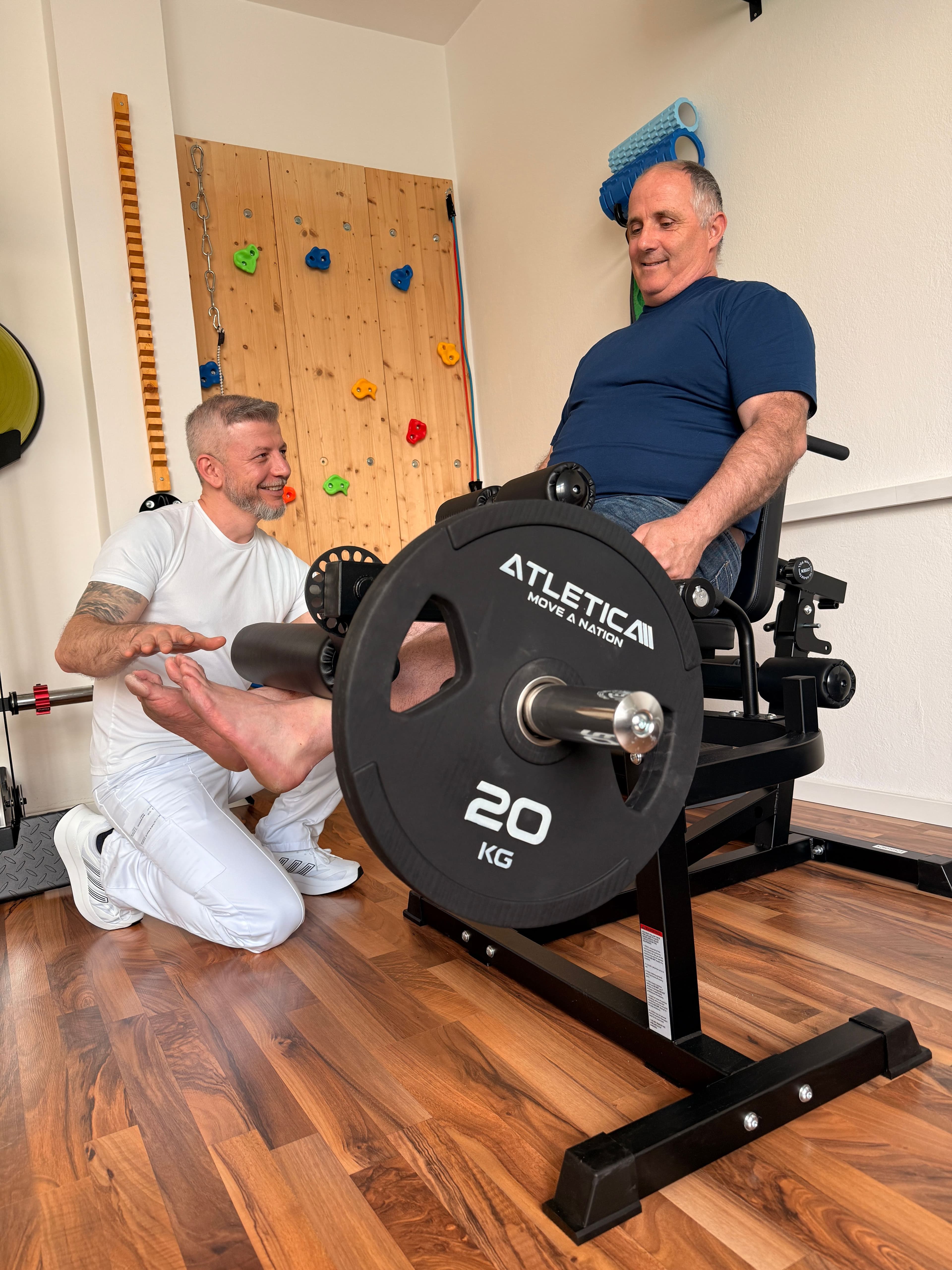
If muscle strength is reduced or physical capacity needs to be developed, individually adapted strength training may form part of physiotherapy treatment.
Exercises and physical loads are adapted to your current physical condition.
The level of load can be gradually adjusted throughout the course of treatment.
Home Exercises and Treatment Duration
Will I Receive Exercises to Do at Home?
Depending on your individual situation, a home exercise programme may be useful.
Exercises should be easy to understand and practical to perform in everyday life.
An individual exercise programme may aim to:
- Support mobility
- Develop muscle strength
- Improve movement control
- Build physical capacity
The number of exercises should be appropriate for your individual situation.
A very extensive exercise programme is not automatically better.
What matters is that exercises are appropriately selected and regularly adjusted.
How Often Do I Need Physiotherapy?
There is no universally applicable number of physiotherapy sessions.
The duration and frequency of treatment depend on various factors.
These include:
- Type of symptoms
- Duration of symptoms
- Injury or surgery
- Initial physical condition
- Personal treatment goals
- Response to physical load
- Progress during treatment
The treatment plan should be reviewed regularly.
An important question is:
How are your symptoms, physical function, and physical capacity developing?
Treatment can then be adjusted based on this progress.
Pain and Safety During Physiotherapy
Does Physiotherapy Have to Be Painful?
No.
Physiotherapy does not necessarily have to be painful.
Certain exercises or movements may temporarily reproduce symptoms.
This does not automatically mean that the movement is harmful.
However, your individual response to movement and physical load should always be taken into account.
Severe, unusual, or significantly increasing symptoms should be discussed and reassessed.
Treatment can then be adjusted accordingly.
When Is Medical Assessment Necessary?
Certain symptoms may require additional medical assessment.
These may include:
- Sudden severe pain
- Significant muscle weakness
- New or pronounced sensory changes
- Problems with bladder or bowel control
- Severe symptoms following an accident
- Fever associated with severe pain
- Unexplained neurological symptoms
- Unusual or rapidly worsening symptoms
If these symptoms occur, further medical assessment may be necessary.
Physiotherapy does not replace necessary medical diagnostics.
Medical Referral and Wahlphysiotherapie in Austria
Physiotherapy With a Medical Referral
In Austria, physiotherapy may be prescribed by a doctor.
The referral generally contains information regarding the prescribed physiotherapy treatment.
Depending on your health insurance provider and individual circumstances, different reimbursement conditions may apply.
For precise information regarding reimbursement, patients should contact their health insurance provider directly.
You are welcome to bring your medical referral to your first appointment.
What Is Wahlphysiotherapie?
Theraist Physiotherapy Bludenz operates as a private physiotherapy practice under the Austrian Wahlphysiotherapie system.
This means that treatment is initially paid for privately by the patient.
Depending on the health insurance provider, the medical referral, and the applicable reimbursement conditions, partial reimbursement may subsequently be possible.
The amount reimbursed depends on the respective health insurance provider and current regulations.
For precise information regarding your individual reimbursement conditions, please contact your health insurance provider directly.
Preparing for Your First Physiotherapy Appointment
What Should I Bring to My First Appointment?
If available, you may bring the following documents to your first appointment:
- E-Card
- Medical referral
- Medical reports
- Surgical reports
- MRI or X-ray reports
- Relevant medical documentation
Comfortable clothing is recommended for the physiotherapy assessment and active exercises.
For lower-limb problems, sports shoes may also be useful depending on the planned assessment.
Physiotherapy in Bludenz and the Surrounding Region
Are you looking for physiotherapy in Bludenz?
At Theraist Physiotherapy Bludenz, individual physiotherapy assessment is at the centre of our approach.
We provide physiotherapy for patients with a range of orthopaedic, postoperative, neurological, and movement-related complaints.
Depending on your individual situation, treatment may include:
- Individual physiotherapy assessment
- Active physiotherapy
- Exercise therapy
- Strength training
- Manual therapy
- Mobilisation
- Postoperative rehabilitation
- Functional training
- Individual exercise programmes
We treat patients from Bludenz and the surrounding region, including Bürs, Nüziders, Ludesch, Thüringen, Brandnertal, Montafon, and Walgau.
Our aim is to assess your current physical situation individually and work with you to develop an appropriate physiotherapy treatment plan.
Please Note: This content is provided for general informational purposes only and does not replace an individual medical or physiotherapy assessment. If you experience new, severe, or unexplained symptoms, a medical evaluation may be necessary.
Important: If you experience sudden paralysis, numbness or loss of sensation, or problems with bladder or bowel control, seek immediate medical attention.
Begin your journey
Fill in the form – we will contact you within 24 hours for a no-obligation first appointment.
Book appointment
